Balance transfer calculator
Work out whether moving credit card debt to a 0% intro APR card saves money once the transfer fee is counted, and what you would need to pay each month to clear it before the intro period ends. Results update as you type.
Results
| Measure | Without transfer | With transfer |
|---|---|---|
| Months to pay off | 53 | 41 |
| Total interest | $2,834 | $947 |
| Interest and fee | $2,834 | $1,097 |
Based on these numbers, transferring saves about $1,737 compared with paying the same $150 a month without transferring, after the $150 fee and $42 of interest while the transfer posts.
At this payment the balance is not cleared when the intro period ends; the remaining amount is charged at the standard rate.
The standard rate on the new card is higher than the average rate on the current cards, so anything left after the intro period costs more than before.
- Payment to clear the balance before the intro period ends
- $367.86 a month for 14 months
Break-even details
| Break-even fee | 21.2% | The fee at which the saving reaches zero, everything else unchanged. |
|---|---|---|
| Break-even month | Month 3 | The first month in which the interest avoided passes the fee. |
| Verdict flips at | $1,668 a month | Above this payment the fee outweighs the interest avoided. |
| Interest avoided during intro | $1,188 | |
| Interest charged after intro | $904 | On the balance left when the intro period ends. |
| Saving vs your current payments | $1,737 | Includes the effect of paying more, so it is not used for the verdict. |
- At this payment the balance is not cleared when the intro period ends; the remaining amount is charged at the standard rate.
- The standard rate on the new card is higher than the average rate on the current cards, so anything left after the intro period costs more than before.
Balance left when the intro period ends
| If you pay | Monthly | Left at month 14 | First month's interest after |
|---|---|---|---|
| Your planned payment | $150 | $3,050 | $61.00 |
| Minimum only | varies | $4,474 | $89.48 |
| Clear-in-time payment | $367.86 | $0 | $0 |
Opening balance $5,150.00 = $5,000.00 transferred + $150.00 fee. Paying only the minimum clears it in 190 months and costs $7,167 in interest.
Side by side: do nothing, transfer, pay more, personal loan
| Scenario | Monthly | Month | Interest | Fees | Cost over 53 months |
|---|---|---|---|---|---|
| Keep paying as now | $150 | 53 | $2,834 | $0 | $7,834 |
| Balance transfer | $150 | 41 | $947 | $150 | $6,097 |
| Same payment, no transfer | $150 | 53 | $2,834 | $0 | $7,834 |
| Personal loan | $195 | 36 | $1,739 | $263 | $7,002 |
The last column counts payments made through month 53 plus whatever is still owed at that point, so a route that never clears is charged for the balance it leaves behind rather than looking cheap.
Month-by-month schedule
41 months. Total interest $904.38, total paid $6,054.38.
| Month | Start | Interest | Payment | Principal | End | Minimum due |
|---|---|---|---|---|---|---|
| 1 | $5,150.00 | $0.00 | $150.00 | $150.00 | $5,000.00 | $51.50 |
| 2 | $5,000.00 | $0.00 | $150.00 | $150.00 | $4,850.00 | $50.00 |
| 3 | $4,850.00 | $0.00 | $150.00 | $150.00 | $4,700.00 | $48.50 |
| 4 | $4,700.00 | $0.00 | $150.00 | $150.00 | $4,550.00 | $47.00 |
| 5 | $4,550.00 | $0.00 | $150.00 | $150.00 | $4,400.00 | $45.50 |
| 6 | $4,400.00 | $0.00 | $150.00 | $150.00 | $4,250.00 | $44.00 |
| 7 | $4,250.00 | $0.00 | $150.00 | $150.00 | $4,100.00 | $42.50 |
| 8 | $4,100.00 | $0.00 | $150.00 | $150.00 | $3,950.00 | $41.00 |
| 9 | $3,950.00 | $0.00 | $150.00 | $150.00 | $3,800.00 | $40.00 |
| 10 | $3,800.00 | $0.00 | $150.00 | $150.00 | $3,650.00 | $40.00 |
| 11 | $3,650.00 | $0.00 | $150.00 | $150.00 | $3,500.00 | $40.00 |
| 12 | $3,500.00 | $0.00 | $150.00 | $150.00 | $3,350.00 | $40.00 |
| 13 | $3,350.00 | $0.00 | $150.00 | $150.00 | $3,200.00 | $40.00 |
| 14 | $3,200.00 | $0.00 | $150.00 | $150.00 | $3,050.00 | $40.00 |
| 15 | $3,050.00 | $61.00 | $150.00 | $89.00 | $2,961.00 | $91.50 |
| 16 | $2,961.00 | $59.22 | $150.00 | $90.78 | $2,870.22 | $88.83 |
| 17 | $2,870.22 | $57.40 | $150.00 | $92.60 | $2,777.62 | $86.10 |
| 18 | $2,777.62 | $55.55 | $150.00 | $94.45 | $2,683.17 | $83.33 |
| 19 | $2,683.17 | $53.66 | $150.00 | $96.34 | $2,586.83 | $80.49 |
| 20 | $2,586.83 | $51.74 | $150.00 | $98.26 | $2,488.57 | $77.61 |
| 21 | $2,488.57 | $49.77 | $150.00 | $100.23 | $2,388.34 | $74.66 |
| 22 | $2,388.34 | $47.77 | $150.00 | $102.23 | $2,286.11 | $71.65 |
| 23 | $2,286.11 | $45.72 | $150.00 | $104.28 | $2,181.83 | $68.58 |
| 24 | $2,181.83 | $43.64 | $150.00 | $106.36 | $2,075.47 | $65.46 |
| 25 | $2,075.47 | $41.51 | $150.00 | $108.49 | $1,966.98 | $62.26 |
| 26 | $1,966.98 | $39.34 | $150.00 | $110.66 | $1,856.32 | $59.01 |
| 27 | $1,856.32 | $37.13 | $150.00 | $112.87 | $1,743.45 | $55.69 |
| 28 | $1,743.45 | $34.87 | $150.00 | $115.13 | $1,628.32 | $52.30 |
| 29 | $1,628.32 | $32.57 | $150.00 | $117.43 | $1,510.89 | $48.85 |
| 30 | $1,510.89 | $30.22 | $150.00 | $119.78 | $1,391.11 | $45.33 |
| 31 | $1,391.11 | $27.82 | $150.00 | $122.18 | $1,268.93 | $41.73 |
| 32 | $1,268.93 | $25.38 | $150.00 | $124.62 | $1,144.31 | $40.00 |
| 33 | $1,144.31 | $22.89 | $150.00 | $127.11 | $1,017.20 | $40.00 |
| 34 | $1,017.20 | $20.34 | $150.00 | $129.66 | $887.54 | $40.00 |
| 35 | $887.54 | $17.75 | $150.00 | $132.25 | $755.29 | $40.00 |
| 36 | $755.29 | $15.11 | $150.00 | $134.89 | $620.40 | $40.00 |
| 37 | $620.40 | $12.41 | $150.00 | $137.59 | $482.81 | $40.00 |
| 38 | $482.81 | $9.66 | $150.00 | $140.34 | $342.47 | $40.00 |
| 39 | $342.47 | $6.85 | $150.00 | $143.15 | $199.32 | $40.00 |
| 40 | $199.32 | $3.99 | $150.00 | $146.01 | $53.31 | $40.00 |
| 41 | $53.31 | $1.07 | $54.38 | $53.31 | $0.00 | $40.00 |
Balance over time
Loading chart.
What a transfer actually costs
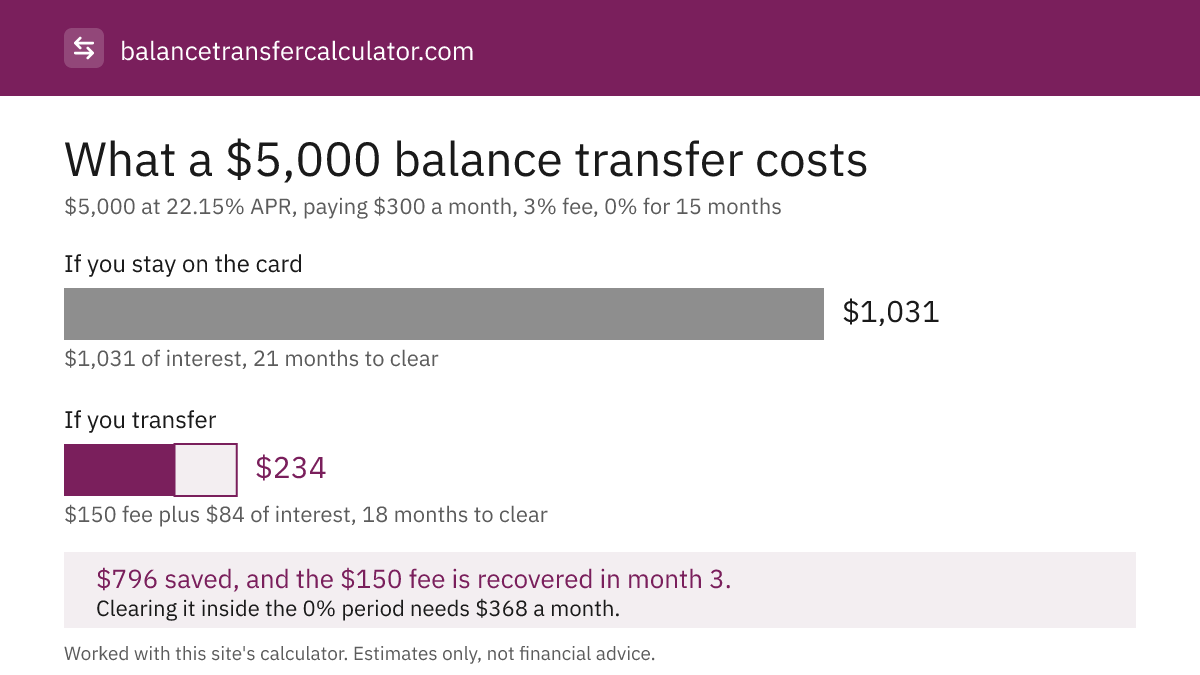
The fee is the part most calculators leave out. On a $5,000 balance at 22.15% APR paid at $300 a month, staying put costs $1,031 of interest over 21 months. Moving it to a card charging 3% for a 15 month 0% period costs $150 in fee and about $84 of interest, most of it on the old card while the transfer posts, and clears three months sooner. That is $796 saved, with the fee recovered in month 3. Change any input above and the verdict changes with it.
Before you transfer
A balance transfer changes where the debt sits, not how much you owe. Four things the numbers above cannot show:
- Applying means a hard inquiry and a new account, which lowers the average age of your accounts. The effect is usually small and fades within a year, but it is real. See how a transfer affects your credit.
- The old card stays open with a zero balance. Roughly half of people who transfer a balance run the old card back up. If that is a risk, the transfer makes things worse, not better.
- Purchases on the new card usually get no grace period while a transferred balance is outstanding, and your minimum payment goes to the 0% balance first. Use a different card for spending.
- The intro period ends on a fixed date, whether or not you have cleared the balance. The "clear in time" payment above is the number to plan around.
If the verdict says a transfer is not worth it, the honest alternatives are paying the same amount on the highest-rate card first, or a personal loan if its APR is well below your cards'.
How the numbers are worked out
Interest is charged monthly at APR ÷ 12 on each balance, the transfer fee is added to the transferred amount, the intro period is shortened by the posting time, and payments above the minimum go to the highest-APR balance first, as US rules require. Every formula, default and source is on the methodology page, along with where our results differ from NerdWallet, Bankrate, Forbes and others.
What makes a balance transfer calculator worth trusting
There is no shortage of them. The NerdWallet balance transfer calculator, the Bankrate balance transfer calculator, WalletHub's and the issuers' own all take the same four inputs and can still hand you four different answers, because the assumption underneath is not the same. Most compare a transfer against carrying on with your current minimum payment. That is the flattering comparison: paying more than the minimum would have cleared the debt faster with or without a transfer, so the savings they report include money the transfer had nothing to do with. This one holds the payment constant on both sides. What is left is what the transfer itself is worth once the fee is paid for, which is the only number that should decide anything.
Two further things get skipped almost everywhere. The fee is often applied as a flat percentage with no minimum, when real cards charge 3% to 5% or $5 to $10, whichever is greater, and on small balances the minimum is what you actually pay. And the intro clock starts when the account opens, not when the money arrives, so the old card keeps charging interest for the two weeks or so the transfer takes to post. Both are modelled here. If you want to compare credit card balance transfer calculators properly, put the same scenario through several and read the assumptions, not the headline saving.
Using this 0% balance transfer calculator with a real offer
The calculator is issuer neutral. It asks for terms, not brands, so a Citi, Discover, Chase, Amex or credit union offer all go in the same four boxes. Take the numbers from the offer you were approved for rather than the advertising: approved intro periods and credit limits are routinely shorter and smaller than the headline, and a limit below your balance means a partial transfer, which changes the answer. Enter the fee percentage, the fee minimum, the intro length in months and the go to APR that applies afterwards.
A true 0% intro APR charges no interest during the period and no retroactive interest afterwards. That is worth stating because deferred interest financing, common on store cards, looks similar and behaves very differently: miss the deadline by a day and the whole period's interest lands at once. If your offer is store financing rather than a credit card, read deferred interest against 0% APR before using any of these numbers.
Everything runs in your browser as you type. Your figures are never uploaded or stored and there is no sign up, which is the only sense in which this is an online balance transfer calculator rather than a service. The site counts page views with Google Analytics and nothing else, as the privacy policy sets out. For balances spread over several cards use the multiple cards calculator, and for the fee on its own the transfer fee calculator. Loan transfers work differently and have their own tools: see the India home loan balance transfer calculator and personal loan transfer calculator. Outside the US, figures and rules change in the UK, Canada and Australia versions.
Should you do a balance transfer?
The calculator answers this with your numbers, above. These are the questions it cannot put on a screen, and the ones worth reading before you apply. A longer treatment is in is a balance transfer worth it.
Should I do a balance transfer?
Only if three things are true: the saving after the fee is worth the effort, you can realistically make the payment that clears the balance before the 0% period ends, and you will not run the old card back up. The calculator answers the first two from your own figures. The third decides most outcomes and no calculator can measure it for you.
Should I transfer my credit card balance, or just pay it down faster?
Pay it down faster either way. A transfer is worth doing on top of that, not instead of it. Put your real payment into the calculator and it holds that payment constant on both sides, so the figure it reports is what moving the debt is worth after the fee. If that figure is small, paying the same amount at the highest-rate card first is simpler and costs nothing.
When is a balance transfer worth it?
When the interest you avoid is comfortably larger than the fee, and the payment that clears the balance inside the intro period is one you can actually make. As a rough guide a 3% fee is recovered in about two months of interest at a 22% APR, so a transfer you can clear in time almost always wins. One you cannot clear leaves the remainder at the go to APR, and then the fee bought you months rather than money.
Is a balance transfer worth it if I cannot clear the balance in time?
Sometimes, but the margin is thin. Whatever is left when the intro period ends is charged at the regular APR of the card from that month on, so the saving is only the interest avoided during the 0% months, minus the fee. The calculator shows the balance left at three payment levels and the first month of interest on it, which is the number to judge this by. There is no retroactive interest on a true 0% card.
Which balance transfer offer is better, a longer 0% period or a lower fee?
It depends on the payment you will make, which is why comparing offers in the abstract does not work. A low fee wins when you can clear the balance quickly, because you never use the extra months. A long intro period wins when your payment needs the time, because a few months of avoided interest at a 20% plus APR outweighs one or two points of fee. Run both offers through the calculator with your real payment and compare the totals.
Should I do a second balance transfer when the 0% period ends?
It is possible and sometimes sensible, but do not plan on it. You pay a fresh fee on the remaining balance, approval is not guaranteed, and issuers increasingly decline applicants who transfer repeatedly. Treat a second transfer as a fallback rather than the plan, and size the payment so the first one finishes the job.
Common questions
How is the transfer fee handled?
The fee (usually 3% to 5% of the amount moved, with a $5 or $10 minimum) is added to your new balance on day one. It sits inside the 0% balance, so it costs nothing during the intro period but is charged at the go-to APR if any of it is still there when the intro period ends.
Why does the calculator compare against paying the same amount without transferring?
Paying more clears debt faster whether or not you transfer. Comparing the transfer with the same payment on your current cards isolates what the transfer itself saves, after its fee. The comparison with your current payments is shown too, but the verdict is not based on it.
What happens if I do not clear the balance before the intro period ends?
Whatever is left is charged at the card's regular APR from that month on. The calculator shows the balance left at three payment levels and the first month's interest on it. There is no retroactive interest on a true 0% APR card; that only happens with deferred-interest store financing.
Does the calculator count the time the transfer takes to post?
Yes. The intro clock starts at account opening, and the old card keeps charging interest until the transfer posts, so the default 14-day posting time shortens the usable 0% window by about half a month and adds a small amount of interest on the old card.
How much can a balance transfer actually save?
The saving is the interest you avoid minus the transfer fee, and it depends far more on what you pay each month than on the size of the intro period. On the $5,000 example above the saving is $796. On the same balance paid at $120 a month the intro period expires with most of the debt still there, and the 3% fee buys very little. Run your own figures rather than trusting a headline number.
Is there a Citi, Discover, Chase or Amex version?
No, and there does not need to be. People search for a Citi balance transfer calculator or a Discover balance transfer calculator, but a transfer is arithmetic on four terms, not a brand. This calculator is issuer neutral and asks for the terms rather than the name, so it works with any card. Take the transfer fee percentage, the fee minimum, the intro period in months and the go to APR from the offer you were actually approved for, not from the marketing page, and enter those. Approved terms often differ from advertised ones.
How does this compare with the NerdWallet, Bankrate or WalletHub balance transfer calculators?
Most calculators compare a transfer against your current minimum payment, which flatters the transfer because paying more would have helped anyway. This one holds the payment constant so the figure you see is what the transfer itself is worth after its fee. It also charges interest on the old card while the transfer posts. The methodology page shows every point where our result differs from theirs and why.
Can I use it for a home loan or personal loan balance transfer?
Not this page. A credit card transfer has a fee, an intro period and a go to rate. A loan transfer, sometimes called a takeover, has processing fees, a remaining tenure and a foreclosure charge on the old lender, so it needs different maths. The India section has dedicated home loan, personal loan, car loan and loan against property transfer calculators.
Which is the best credit card balance transfer calculator?
The one that shows its assumptions. A calculator that reports a large saving without telling you what it compared against, whether it applied the fee minimum, or whether it charged interest while the transfer posted, is not giving you a figure you can check. Put the same scenario through two or three, then read the methodology behind whichever number you plan to act on.
Is the calculator free, and does anything I type get sent anywhere?
It is free, there is no sign up and no email is asked for. The maths runs entirely in your browser, so balances and APRs never leave your device and are not stored or logged. There are no affiliate links to card issuers, so nothing here has a reason to prefer one answer over another.